
Pharma QC Resume Examples, Skills & Keywords
A strong pharma QC resume can help you present your laboratory knowledge, testing experience, and quality control skills in a way that recruiters can quickly understand. Whether you are a fresher, a quality control analyst, or an experienced pharmaceutical professional, your resume should clearly show what you know and how you have applied it.
Pharmaceutical quality control involves much more than routine laboratory testing. QC professionals may work with raw materials, in-process samples, finished products, analytical instruments, documentation, and laboratory procedures. Your resume should reflect the areas that match the job you are applying for.
In this guide, you will find pharma QC resume examples, important skills, useful keywords, resume-writing tips, and examples of how to describe your experience.
⭐ Rated 4.8★ on Google | Trusted by 10,000+ Professionals
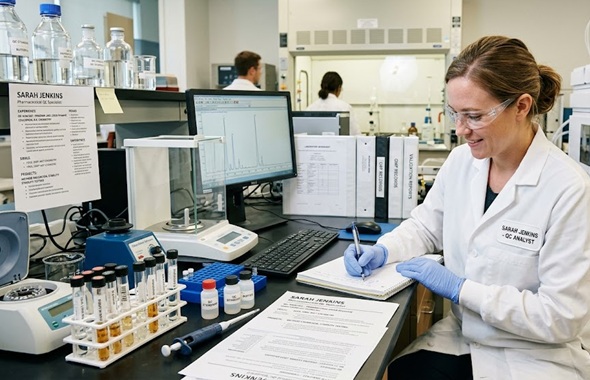
What Does a Pharma QC Professional Do?
A pharmaceutical quality control professional is responsible for testing and evaluating materials and products to make sure they meet established quality requirements.
Depending on the organization and position, QC responsibilities may include:
- Testing raw materials and finished pharmaceutical products
- Performing chemical and instrumental analysis
- Operating laboratory equipment and analytical instruments
- Recording and reviewing test results
- Following SOPs and laboratory procedures
- Maintaining laboratory records and documentation
- Supporting investigations of out-of-specification results
- Assisting with method validation and analytical activities
- Following GMP and safety requirements
- Maintaining laboratory cleanliness and compliance
Because QC roles can differ from one company to another, your resume should focus on the responsibilities and techniques that are relevant to the specific job description.
How to Write a Pharma QC Resume
A good pharma QC resume should be clear, concise, and easy to scan. Recruiters often look at a resume quickly, so the most relevant information should be easy to find.
A typical structure includes:
- Contact information
- Professional summary
- Technical skills
- Work experience
- Education
- Certifications or training
- Instruments and laboratory techniques
- Additional information, when relevant
Avoid filling the resume with long paragraphs. Short bullet points usually make your responsibilities and achievements easier to understand.
Pharma QC Resume Example for a Fresher
If you are a fresher, you may not have pharmaceutical industry experience yet. That does not mean your resume has to be empty.
Focus on your education, laboratory training, analytical techniques, instruments, project work, and relevant coursework.
Example Resume Summary
Pharmaceutical Quality Control Fresher with a background in pharmaceutical sciences and practical knowledge of laboratory testing, analytical techniques, GMP principles, SOPs, and quality documentation. Familiar with basic pharmaceutical analysis, laboratory safety, and handling of common analytical instruments. Looking to begin a career in pharmaceutical quality control and contribute to accurate and reliable laboratory operations.
Example Skills
- Pharmaceutical Quality Control
- Quality Testing
- GMP and GLP
- SOP Compliance
- Laboratory Documentation
- Raw Material Testing
- Finished Product Testing
- Analytical Chemistry
- Basic Chromatography
- HPLC Fundamentals
- UV-Visible Spectrophotometry
- Dissolution Testing
- pH Testing
- Titration
- Data Recording
- Laboratory Safety
Example Project
Pharmaceutical Analysis Project
- Performed laboratory analysis of pharmaceutical samples as part of academic project work.
- Followed laboratory procedures and recorded test observations accurately.
- Applied basic analytical techniques to evaluate sample quality.
- Maintained laboratory records according to prescribed procedures.
Pharma QC Resume Example for Experienced Professionals
Experienced QC professionals should focus less on general responsibilities and more on their actual contributions, testing expertise, instruments, and quality systems knowledge.
Example Resume Summary
Quality Control professional with experience in pharmaceutical laboratory testing, analytical procedures, documentation, and GMP-compliant operations. Experienced in testing raw materials, in-process samples, and finished products using analytical techniques and laboratory instruments. Familiar with OOS investigations, SOP compliance, data recording, and maintaining accurate quality control documentation.
Example Experience
Quality Control Analyst
ABC Pharmaceuticals | 2023–Present
- Perform routine testing of raw materials, in-process samples, and finished products according to approved procedures.
- Operate laboratory instruments such as HPLC, UV-Visible spectrophotometer, dissolution apparatus, and pH meter.
- Review analytical results and maintain complete laboratory documentation.
- Follow approved SOPs, GMP requirements, and laboratory safety procedures.
- Support investigations related to out-of-specification and atypical results.
- Assist with instrument calibration, maintenance, and laboratory compliance activities.
- Maintain accurate records of analytical testing and results.
Important Pharma QC Resume Skills
The skills section is one of the most important parts of your resume. It gives recruiters a quick overview of your technical capabilities.
Here are some useful skills to consider if they genuinely match your experience.
Technical QC Skills
- Pharmaceutical Quality Control
- Analytical Testing
- Raw Material Analysis
- Finished Product Testing
- In-Process Testing
- Stability Testing
- Sampling
- Assay Testing
- Dissolution Testing
- Content Uniformity
- Related Substances Testing
- pH Testing
- Moisture Analysis
- Titration
- Analytical Method Testing
Laboratory Instrument Skills
Depending on your experience, you may include instruments such as:
- HPLC
- UV-Visible Spectrophotometer
- Dissolution Apparatus
- Disintegration Tester
- Friability Tester
- Karl Fischer Titrator
- pH Meter
- Analytical Balance
- Conductivity Meter
- FTIR
- Gas Chromatography (GC)
Do not list an instrument simply because you have seen it during training. Include it only when you have practical knowledge of operating or working with it.
GMP, GLP and Documentation Skills
Pharmaceutical QC jobs require strong attention to procedures and documentation. Relevant skills can include:
- Good Manufacturing Practices (GMP)
- Good Laboratory Practices (GLP)
- Standard Operating Procedures (SOPs)
- Laboratory Documentation
- Data Integrity
- Batch Records
- Analytical Worksheets
- Specification Review
- Deviation Documentation
- OOS Investigation
- CAPA Awareness
- Change Control Awareness
- Calibration Records
If you have hands-on experience with a particular quality system, describe how you used it rather than simply adding the term to a keyword list.
Pharma QC Resume Keywords
Using relevant keywords can improve the chances of your resume being identified by an Applicant Tracking System (ATS).
Some commonly relevant pharma QC resume keywords include:
- Pharmaceutical Quality Control
- Quality Control Analyst
- QC Chemist
- Quality Control Chemist
- Pharmaceutical Testing
- Analytical Testing
- HPLC
- UV Spectrophotometer
- Dissolution
- Assay
- Stability Testing
- Raw Material Testing
- Finished Product Testing
- GMP
- GLP
- SOP
- OOS
- CAPA
- Data Integrity
- Analytical Method Validation
- Method Verification
- Laboratory Documentation
- Quality Assurance
- Pharmaceutical Analysis
The best approach is to compare these terms with the actual job description. Use keywords that accurately represent your qualifications rather than adding unrelated terms just to improve ATS matching.
How to Write Pharma QC Resume Experience
One common mistake is writing job responsibilities as a simple list without showing the type of work performed.
Instead of writing:
Responsible for HPLC testing.
You could write:
Performed routine HPLC analysis of pharmaceutical samples according to approved analytical procedures and documented results accurately.
The second version provides more useful information while remaining concise.
Another example:
Basic:
Worked on laboratory instruments.
Better:
Operated and maintained laboratory instruments including HPLC, UV-Visible spectrophotometer, dissolution apparatus, and analytical balance as required for routine testing.
If you have measurable achievements, you can include them when the figures are genuine.
For example:
Completed routine testing and documentation for multiple batches while meeting laboratory turnaround requirements.
Pharma QC Resume for HPLC Experience
HPLC is a valuable keyword for many pharmaceutical QC positions. If you have practical HPLC experience, make it visible in both your skills and work experience sections.
You can mention areas such as:
- HPLC operation
- Sample preparation
- Mobile phase preparation
- System suitability testing
- Chromatographic analysis
- Column handling
- Peak identification
- Result calculation
- HPLC troubleshooting
- Instrument maintenance
Only include advanced HPLC activities if you have actually performed them.
Pharma QC Resume for Freshers
Freshers often worry that they do not have enough experience to create a competitive resume. The solution is to make your academic and practical training relevant.
You can highlight:
- Laboratory projects
- Internship experience
- Industrial training
- Pharmaceutical analysis
- Instrument handling
- Analytical techniques
- GMP/GLP knowledge
- Relevant certifications
- Dissertation or research work
For example:
Industrial Training – Quality Control Laboratory
- Observed and assisted with routine pharmaceutical laboratory testing.
- Gained exposure to HPLC, UV-Visible spectrophotometry, dissolution testing, and basic laboratory documentation.
- Learned the importance of SOP compliance, GMP practices, and laboratory safety.
This is more useful than simply writing “Completed industrial training.”
Education Section for a Pharma QC Resume
Place your most relevant educational qualification first.
For example:
Bachelor of Pharmacy (B.Pharm)
XYZ University | 2022
Relevant areas:
- Pharmaceutical Analysis
- Pharmaceutical Chemistry
- Quality Control
- Instrumental Methods of Analysis
- Microbiology
You do not need to list every subject you studied. Select subjects that support the position you are applying for.
Certifications to Include
Relevant certifications can strengthen a pharma QC resume, particularly for freshers or candidates changing roles.
Depending on what you have completed, you may include training in:
- GMP
- GLP
- HPLC
- Pharmaceutical Quality Control
- Analytical Method Validation
- Data Integrity
- Laboratory Safety
- Pharmaceutical Analysis
Always mention the actual certification or training you completed rather than listing courses you have only considered or started.
Common Mistakes to Avoid
Even candidates with good technical knowledge can weaken their resume through simple mistakes.
1. Listing Too Many Skills
A long list of skills does not automatically make a resume stronger. Recruiters are more interested in skills that are relevant to the position.
2. Adding Instruments You Cannot Operate
Do not add HPLC, GC, FTIR, or other instruments just because they appear frequently in job advertisements. Be prepared to discuss every technical skill you list during an interview.
3. Using the Same Resume for Every Job
A QC chemist working mainly with HPLC may need a different emphasis than a candidate working in microbiological quality control. Adjust your resume based on the position.
4. Writing Long Paragraphs
Large blocks of text make resumes difficult to scan. Use short bullet points with clear action words.
5. Ignoring Documentation
QC is not only about laboratory testing. Documentation, SOP compliance, data integrity, investigations, and GMP practices can be equally important.
Pharma QC Resume Format for ATS
An ATS-friendly resume should use a simple structure.
Keep these points in mind:
- Use standard section headings.
- Include relevant job-specific keywords naturally.
- Use simple fonts and consistent formatting.
- Avoid excessive graphics and decorative elements.
- Keep important information in the main body of the resume.
- Use bullet points for responsibilities and achievements.
- Check the resume for spelling and formatting errors.
- Save the resume in the file format requested by the employer.
A clean resume is generally easier for both ATS software and human recruiters to read.
Frequently Asked Questions About Pharma QC Resumes
What should I include in a pharma QC resume?
Include your professional summary, technical skills, pharmaceutical testing experience, laboratory instruments, GMP/GLP knowledge, work experience, education, certifications, and relevant projects.
Which skills are important for a pharma QC resume?
Important skills can include pharmaceutical analysis, HPLC, UV spectroscopy, dissolution testing, raw material testing, finished product testing, GMP, GLP, SOP compliance, documentation, OOS investigation, and data integrity, depending on the job.
What keywords should I use in a pharma QC resume?
Useful keywords may include pharmaceutical quality control, QC analyst, QC chemist, HPLC, analytical testing, assay, dissolution, stability testing, GMP, GLP, SOP, OOS, CAPA, data integrity, and pharmaceutical analysis.
Can a fresher create a pharma QC resume without industry experience?
Yes. A fresher can highlight education, internships, laboratory projects, industrial training, analytical techniques, instrument exposure, certifications, and relevant pharmaceutical knowledge.
How long should a pharma QC resume be?
For many entry-level candidates, one page is enough. Experienced professionals can use two pages when they have relevant experience that needs to be presented.
Final Thoughts
Your pharma QC resume should do more than list your qualifications. It should show recruiters what type of quality control work you understand, which laboratory techniques you can perform, and how your experience matches the position.
Keep the resume focused, use relevant pharmaceutical QC keywords, and avoid adding skills you cannot confidently discuss in an interview. Whether you are a fresher or an experienced QC professional, a clear and well-targeted resume can make it easier for employers to see your potential.