
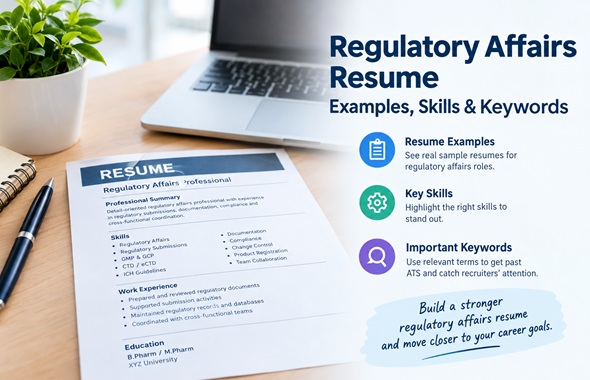
Regulatory Affairs Resume Examples, Skills & Keywords
A strong regulatory affairs resume should do more than list your education and previous jobs. It should show recruiters that you understand regulatory requirements, documentation, submissions, compliance, and the standards that matter in the pharmaceutical, biotechnology, medical device, or healthcare industry.
Whether you are a fresh graduate, an experienced regulatory professional, or planning to move into regulatory affairs from another pharmaceutical role, your resume should make your relevant knowledge easy to find.
This guide explains what to include in a regulatory affairs resume, which skills and keywords to use, and how to write experience that gets attention from recruiters and Applicant Tracking Systems (ATS).
⭐ Rated 4.8★ on Google | Trusted by 10,000+ Professionals
What Does a Regulatory Affairs Professional Do?
Regulatory affairs professionals help companies meet the requirements set by health authorities and other regulatory bodies. Their work can involve preparing documents, supporting regulatory submissions, maintaining product information, reviewing changes, and coordinating with different teams.
Depending on the organization and job title, responsibilities may include:
- Preparing and reviewing regulatory documents
- Supporting regulatory submissions
- Maintaining product registration information
- Reviewing product changes for regulatory impact
- Coordinating with quality, clinical, manufacturing, and R&D teams
- Tracking submission timelines and approvals
- Supporting responses to regulatory queries
- Maintaining compliance with applicable regulations and guidelines
- Managing regulatory databases and documentation
Your resume should highlight the responsibilities that match the position you are applying for rather than listing every task you have performed.
How to Write a Regulatory Affairs Resume
A well-structured regulatory affairs resume normally includes the following sections:
- Contact Information
- Professional Summary
- Regulatory Affairs Skills
- Professional Experience
- Education
- Certifications or Training
- Regulatory Projects or Relevant Experience
Keep the layout clean and easy to scan. Avoid excessive graphics, complicated tables, or unusual fonts, especially when applying through online job portals.
Regulatory Affairs Resume Summary Example
Your professional summary should quickly explain your experience, industry background, and strongest regulatory skills.
Experienced Regulatory Affairs Resume Example
Regulatory Affairs professional with experience supporting regulatory submissions, documentation, compliance activities, and product registration processes. Skilled in regulatory document review, submission tracking, cross-functional coordination, and maintaining accurate regulatory records. Familiar with pharmaceutical regulations, quality requirements, and regulatory guidelines.
Entry-Level Regulatory Affairs Resume Example
Detail-oriented pharmaceutical graduate with knowledge of regulatory affairs, documentation, drug regulations, compliance requirements, and regulatory submission processes. Familiar with pharmaceutical quality systems and regulatory guidelines, with strong documentation, analytical, and communication skills.
If you are a fresher, focus on your education, regulatory training, academic projects, internships, and relevant technical knowledge rather than trying to make your experience sound more senior than it is.
Regulatory Affairs Resume Skills
The skills section is important because recruiters and ATS software often look for specific terms related to the job description.
Here are some useful regulatory affairs skills to consider:
Technical Skills
- Regulatory Affairs
- Regulatory Submissions
- Regulatory Documentation
- Product Registration
- Regulatory Compliance
- Submission Management
- Regulatory Intelligence
- Document Management
- Change Control
- Variation Management
- Dossier Preparation
- Regulatory Review
- Labeling Compliance
- Product Lifecycle Management
- Submission Tracking
- Regulatory Database Management
- SOP Compliance
- Quality Management Systems
- Good Manufacturing Practices (GMP)
- Good Clinical Practice (GCP)
- Good Documentation Practices (GDP)
Only include skills you genuinely understand or have used. Adding a long list of unfamiliar keywords can make your resume look less credible.
Regulatory Guidelines and Standards
Depending on your target role, mentioning relevant regulations and guidelines can strengthen your resume.
Examples include:
- ICH Guidelines
- GMP
- GCP
- GLP
- GDP
- CTD
- eCTD
- Drug regulatory requirements
- Clinical trial regulations
- Pharmaceutical quality requirements
- Medical device regulations
The exact requirements vary depending on the country, product type, and position, so tailor this section to the job description.
Regulatory Affairs Resume Keywords
Using relevant keywords can help your resume perform better in ATS screening.
Some commonly used regulatory affairs resume keywords include:
Regulatory Affairs, Regulatory Compliance, Regulatory Submissions, Dossier Preparation, CTD, eCTD, ICH Guidelines, GMP, GCP, Product Registration, Regulatory Documentation, Submission Management, Regulatory Intelligence, Labeling, Variation Management, Change Control, Regulatory Strategy, Health Authority, Product Lifecycle Management, Compliance, Quality Systems, SOP, Documentation, Submission Tracking.
Do not simply place all these keywords in a separate section. Where possible, use them naturally in your summary, skills, and work experience.
Regulatory Affairs Resume Experience Examples
Your work experience should explain what you actually did and, where possible, show the result or scope of your work.
Example 1: Regulatory Affairs Executive
Regulatory Affairs Executive
- Prepared and reviewed regulatory documents for product registration and submission activities.
- Coordinated with quality, manufacturing, R&D, and other teams to collect required regulatory information.
- Maintained regulatory records and monitored submission timelines.
- Supported responses to regulatory queries and documentation requests.
- Reviewed product changes to identify potential regulatory requirements.
- Assisted with maintaining product registration information and regulatory databases.
Example 2: Regulatory Affairs Associate
Regulatory Affairs Associate
- Supported preparation and compilation of regulatory submission documents.
- Reviewed documents for completeness, consistency, and compliance with applicable requirements.
- Assisted in preparing responses to health authority questions.
- Maintained submission trackers and regulatory documentation.
- Coordinated with cross-functional teams to obtain supporting documents.
- Supported lifecycle management activities for approved products.
Example 3: Regulatory Affairs Fresher
If you are applying for your first regulatory affairs position, you can focus on academic knowledge and practical training.
Regulatory Affairs Trainee / Intern
- Studied pharmaceutical regulatory requirements and regulatory submission processes.
- Assisted with reviewing regulatory documents under supervision.
- Gained practical exposure to regulatory documentation and submission tracking.
- Learned about CTD structure, ICH guidelines, GMP requirements, and pharmaceutical compliance.
- Supported document organization and maintenance of regulatory records.
Regulatory Affairs Resume for Freshers
Freshers should not worry if they do not have several years of regulatory experience. Instead, make the relevant parts of your education and training more visible.
For example, you can include:
Education
Bachelor of Pharmacy (B.Pharm)
XYZ University | 2022–2026
Relevant Knowledge
- Pharmaceutical Regulatory Affairs
- Drug Regulatory Requirements
- ICH Guidelines
- GMP
- CTD and eCTD
- Regulatory Documentation
- Pharmaceutical Quality Systems
- Drug Development Process
Academic Project
Regulatory Review of a Pharmaceutical Product
- Studied regulatory requirements related to pharmaceutical product registration.
- Reviewed the role of regulatory documentation in product approval.
- Studied the basic structure and purpose of a Common Technical Document.
- Prepared an academic report covering regulatory and compliance considerations.
This approach gives recruiters evidence of your interest and knowledge without overstating your experience.
How to Write Regulatory Affairs Resume Bullet Points
Avoid vague statements such as:
Responsible for regulatory documentation.
A stronger version would be:
Prepared and maintained regulatory documentation while coordinating with cross-functional teams to support submission activities.
Instead of:
Worked on compliance.
Try:
Supported compliance activities by reviewing documentation against applicable procedures and regulatory requirements.
The second versions provide more context and show how you used your skills.
Regulatory Affairs Resume for Pharmaceutical Professionals
If you already work in another pharmaceutical function, such as quality assurance, quality control, production, or clinical research, you may have transferable experience.
For example, a Quality Assurance professional moving into regulatory affairs could highlight experience with:
- GMP documentation
- SOPs
- Change control
- Deviations
- CAPA
- Audits
- Batch documentation
- Quality systems
- Compliance activities
- Regulatory inspections
The key is to connect your existing experience to regulatory responsibilities without claiming experience you do not have.
Common Mistakes in a Regulatory Affairs Resume
Even qualified candidates can weaken their resumes with avoidable mistakes.
1. Using the Same Resume for Every Job
Regulatory affairs roles can differ significantly. A position focused on submissions may require different keywords from one focused on compliance, labeling, or medical devices.
Customize your resume according to the job description.
2. Listing Too Many Unrelated Skills
A long skills list does not automatically make a resume stronger. Prioritize skills that are relevant to the position.
3. Writing Only Job Duties
Simply copying responsibilities from a job description can make your experience section feel generic.
Where possible, mention the scope of your work, documents handled, teams supported, or improvements you contributed to.
4. Ignoring ATS Formatting
Use standard headings such as Professional Summary, Skills, Work Experience, Education, and Certifications.
Keep the formatting simple so ATS software can read your information correctly.
5. Adding Regulations You Do Not Know
Do not add ICH, GMP, CTD, eCTD, or other regulatory terms just because they appear frequently in job advertisements.
Only include them when you have relevant knowledge, training, or experience.
How Long Should a Regulatory Affairs Resume Be?
For most candidates, a one- or two-page resume is enough.
Freshers and candidates with limited experience should generally aim for one page if they can present their qualifications clearly. Professionals with several years of relevant experience may need two pages.
The goal is not to include everything you have ever done. The goal is to include the information that helps the employer understand your suitability for the position.
Regulatory Affairs Resume Checklist
Before submitting your resume, check the following:
- Your contact information is correct.
- Your target role is clear.
- The focus is on regulatory affairs-related experience.
- Your professional summary is relevant to the position.
- Important regulatory skills are easy to find.
- Relevant keywords from the job description are included naturally.
- Your work experience uses clear bullet points.
- Your achievements are included where possible.
- Your education and certifications are accurate.
- The resume has a clean, ATS-friendly format.
- There are no spelling or grammatical errors.
Frequently Asked Questions About Regulatory Affairs Resumes
What skills should I put on a regulatory affairs resume?
Important skills can include regulatory submissions, regulatory documentation, compliance, dossier preparation, CTD/eCTD, ICH guidelines, GMP, submission tracking, product registration, regulatory intelligence, labeling, and change control. Choose skills that genuinely match your experience and the position.
What should a regulatory affairs fresher include on a resume?
A fresher can include a relevant degree, regulatory affairs training, internships, academic projects, technical knowledge, certifications, and relevant skills. Highlight your understanding of regulatory documentation, pharmaceutical regulations, GMP, ICH guidelines, and submission processes where applicable.
Is regulatory affairs a good career for pharmacy graduates?
Yes. Regulatory affairs is one of the career paths available to pharmacy graduates. Depending on their qualifications and interests, candidates can explore roles involving regulatory submissions, compliance, documentation, product registration, labeling, and regulatory support.
Should I include ICH guidelines on my resume?
If you have studied or worked with ICH guidelines, they can be included as a relevant skill or area of knowledge. Avoid listing guidelines that you cannot confidently discuss during an interview.
How can I make my regulatory affairs resume ATS-friendly?
Use standard resume headings, simple formatting, relevant job-specific keywords, readable fonts, and clear bullet points. Avoid excessive graphics, text boxes, and complicated layouts that can interfere with ATS parsing.
Final Thoughts
A good regulatory affairs resume should make your relevant knowledge and experience easy to understand within a few seconds. Whether you are an experienced professional or a fresher, focus on the regulatory responsibilities, skills, guidelines, and documentation work that match the position you want.
Most importantly, keep your resume accurate. A focused resume with relevant regulatory keywords and clear examples is much more effective than one filled with unnecessary information.
Take the job description as your guide, identify the skills the employer is looking for, and then show where you have developed or used those skills in your education, training, projects, or professional experience.